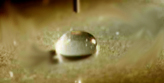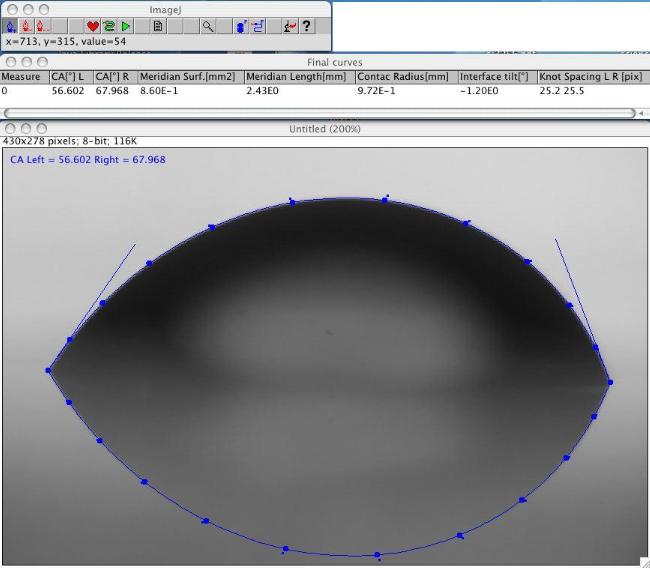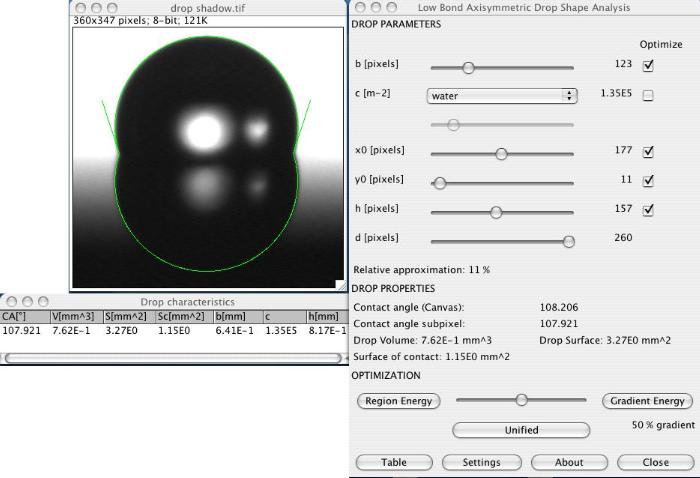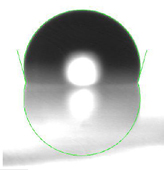

Contact angle is a simple and yet powerful tool for characterizing three-phase junctions. The technique of the sessile drop is today the most widely used method to measure this parameter. The commercial softwares available today are still very limited. They are often dependant of one measurement setup, and may fail under non-standard conditions.
We propose, here, two new methods to high-accuracy measure contact angles:
References[1] A.F. Stalder, T. Melchior, M. Müller, D. Sage, T. Blu, M. Unser, "Low-Bond Axisymmetric Drop Shape Analysis for Surface Tension and Contact Angle Measurements of Sessile Drops," Colloids and Surfaces A: Physicochemical and Engineering Aspects, 2010. [2] A.F. Stalder, G. Kulik, D. Sage, L. Barbieri, P. Hoffmann, "A Snake-Based Approach to Accurate Determination of Both Contact Points and Contact Angles," Colloids And Surfaces A: Physicochemical And Engineering Aspects, 2006. Main Features
Free software for high precision contact angle measurementThe software is based on a plugin for ImageJ, a general purpose free image-processing package. ImageJ has a public domain licence; it runs on several plateforms: Unix, Linux, Windows and Mac OS X. Warning: Some users have encountered incompatibility with ImageJ versions higher than 1.47. In case of troubles, we recommend to use the ImageJ version 1.46 including Java. This version ij147-jdk6-64bit-setup.exe or ij147-jdk6-setup.exe is available at: http://imagej.nih.gov/ij/download/ 1. InstallationGet a copy of ImageJ. and download the plugin drop_analysis.zip. Extract drop_analysis.zip in the "plugins" folder of ImageJ. All the files should extract in a new folder "drop_analysis". The whole process should not take more than a couple of minutes. 2. How of useOpen a drop image. Ensure that the image is grayscale. In the "plugin" menu, go under "drop_analysis" and choose one of the two methods: "LB_ADSA" or "DropSnake". 3. Contact4. Conditions of useYou are free to use this software for research purposes, but you should not redistribute it without our consent. In addition, we expect you to include adequate citation whenever you present or publish results that are based on it. 5. Screenshot
Thanks to Laura Barbieri and to Marco Brugnara for the images. |
Download
drop_analysis.zip
Warning: Some of the unzip tools produce a drop_analysis folder inside of a drop_analysis folder. This hierarchical structure is not compatible for the image plugins. The correct structure is: ImageJ » plugins » drop_analysis » drop_analysis.jar
|