Contents
- Types
- Pointers/Arrays
- Functions
- Preprocessor
- Compilation
- Dynamic library
Prerequisite: Basic knowledge of C
Reference: The C Language (ANSI C), Brian W. Kernighan & Denis M. Ritchie
1. Types
Variables = {Type, Identificator, Value}
Scalar types
| |
Typical implementation
It is not a rule
|
Suffixe |
Example |
| INTEGER |
|
|
|
| char |
8 bits [-127..128] |
|
v='a'; |
| unsigned char |
8 bits [0..255] |
|
|
| short (short int) |
16 bits [-32768..32767] |
|
|
| unsigned short |
16 bits [0..65535] |
|
|
| int |
16 bits do not use |
default |
v=3; |
| unsigned int |
16 bits do not use |
U |
v=3U; |
| long (long int) |
32 bits |
L |
v=3L; |
| unsigned long |
32 bits |
UL |
v=3UL; |
| REAL |
|
|
|
| float |
32 = {1+24+7} bits |
F |
V3.0F; |
| double |
64 = {1+53+10} bits |
default |
v=3.0; |
| long double |
80 = {1+64+15} bits |
|
|
See the file <limits.h> and <float.h> to know the limitations.
Conversion
- Explicit: Casting example(double)var;
- Implicit: Rules of C. Be careful ! Prefer always explicit conversion.
Structure
Data composed as a set of variables
struct TImage {
	float *Data;
	long Nx, Ny;
};
How to access to a field? . or ->
	struct TImage s;	/* structure */
	struct TImage *ps;	/* pointer to structure */

		s.Nx = 10L;
		ps->nx = 10L;
Enum
Type given a list of constants
		enum TOpenDay {Monday, Tuesday, Wednesday, Thursday};
		enum TOpenDay Today;
		Today = Tuesday;
2. Pointers/Arrays
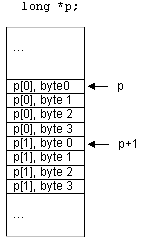
Declaration of a pointer
		short *ps;
		short *ps = (short *)NULL;
Unary operators
& provide the address of an object: p = &a;
* provide the content of an address: a = *p;
|
|
 |
Access to pointed data
Using index notation
				long Summation(long *p, long n)
				{
				long i, sum=0L;
					for(i=0L; i<n; i++) {
						sum += p[i];
					}
					return(sum);
				}
|
Scanning from 0 to n-1 |
The addresses are numerical values: arithmetic operations are possible
				long Summation(long *p, long n)
				{
				long i, sum=0L;

					for(i=0L; i<n; i++) {
						sum += *p++;
					}
					return(sum);
				}
|
Where is p now ? |
Question: What is the difference between *(p++); and (*p)++; ?
Dynamic allocation
malloc: reserved a block of memory
free: release the reserved block
				long *p;

				p = (long *)malloc((size_t)(1000L*(long)sizeof(long)));
				if ( p == (long *)NULL)	{
					return (ERROR);
				}
				...
				free(p);
|
Don't forget
To allocate enough memory for your data.
To check if there's available memory.
To release the memory after usage.
|
Multidimensionnal arrays
The array data are organized follow as a raster:
How to access to a points (i,j,k) in volume of dimension [nx,ny,nz]
Value = Volume[i + nx*(j+ny*k)];
3. Functions
Modularity
Create a function when the inputs and outputs are well defined.
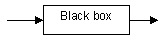
Passing parameters
- By value: The function works with a copy of the parameters: the parameters aren't modified by the function.
double BSpline( double x, long Order)
- By address: Give the pointer to the function: by this way the function can modify the parameters.
void Sobel( double *input, double *output)
Return
Return nothing:
			void Activate()
			{
				...
				return;
				...
			}
Return result:
			long GetLength()
			{
				...
				return(d);
				...
			}
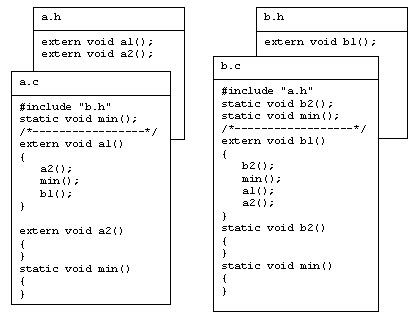
Scope: extern vs static
Good practice to explicity qualify what it is the scope of a function.
4. Preprocessor
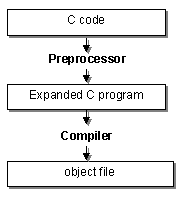
Directive #include
Causes a copy of a specific files in place of the directive
2 forms:
- #include <stdio.h> < > for the C standard libraries
- #include "myfile.h" " " for the user headers
Directive #define, #undef
Usage 1: Create symbolic constants or macro (prefer functions instead macros)
		#undef PI
		#define PI ((double)3.14159265358979323846264338327950288419716939937510)
		#ifdef, #ifndef
Usage 2: Allow conditional compilation
		#undef DEBUG
		#define DEBUG
		...
		#ifdef DEBUG
		printf("%d", a);
		#endif
5. Compilation
Compilation phases
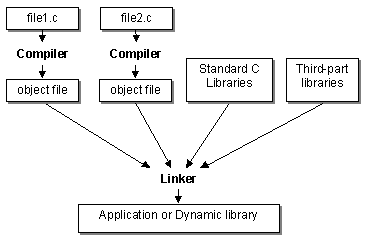
Settings of your compiler
- Include files: Announce where are the include files
- Optimization: Good compromize among Speed / Small Code / Easy to debug
- Warning: Choose what are the level of warnings
6. Dynamic library
The compilation can produce an Application or Dynamic library
| |
Application |
Dynamic library |
| |
Stand-alone |
Run inside an application |
| Loading |
At the launch |
When the calling application use the library |
| Entry point |
1 entry: main() |
No main() function
The list of the callable functions are specified |
| Standard I/O |
Usage of the console I/O: printf(),… |
Don’t use the standard I/O. You don't know which application use your dynamic library |
| Windows |
Executable/Application |
Dynamic link library (.dll) |
| Macintosh |
Application |
Shared Library (.shlb) |
| Unix |
Executable |
Dynamic library (.so) |
Execise 1: Design
Design a program for interactive exploration of 3D volumes of medical data. Identify user needs, propose a user interface. The design should include a short description of user interaction, short description of the internals, description of all functions and data structures.
Exercise 2: Using pointers
We would like to create a button from an image.
Source image 
Result image 
The size of the border is a parameter.
There are two basic operations:
- Rescale the gray level of the input image from 0 to 255.
- Add border around the image, dark gray in the south and east sides and light gray in the north and west sides. On the Macintosh, you find an empty framework file createbutton.c in the bilib:student that you can complete.
The interface to IDL is already done. So launch IDL, run init and the choose the dynamic library student.shlb. Then you can run for example:
IDL> show, createbuttonnowidget(lena(), border=10)
Exercise 3: Image processing example
We would like to write a function that does a smoothing filter using the moving average algoritm in a image (2D array) with mirror boundary conditions. The length of the moving window is a parameter. On the Macintosh, you find an empty framework file movingaverage.c in the bilib:student where that you can complete. The interface to IDL is already done. So launch IDL, run init and the choose the dynamic library student.shlb. Then you can run for example:
IDL> show, movingaveragenowidget(lena(), length=10)
Optional: extend this filter for a volume (3D array).
|