
Deep neural networks to reconstruct super-resolution MRI for liver and kidney 3D modeling
Automn 2022
Master Semester Project
Project: 00428
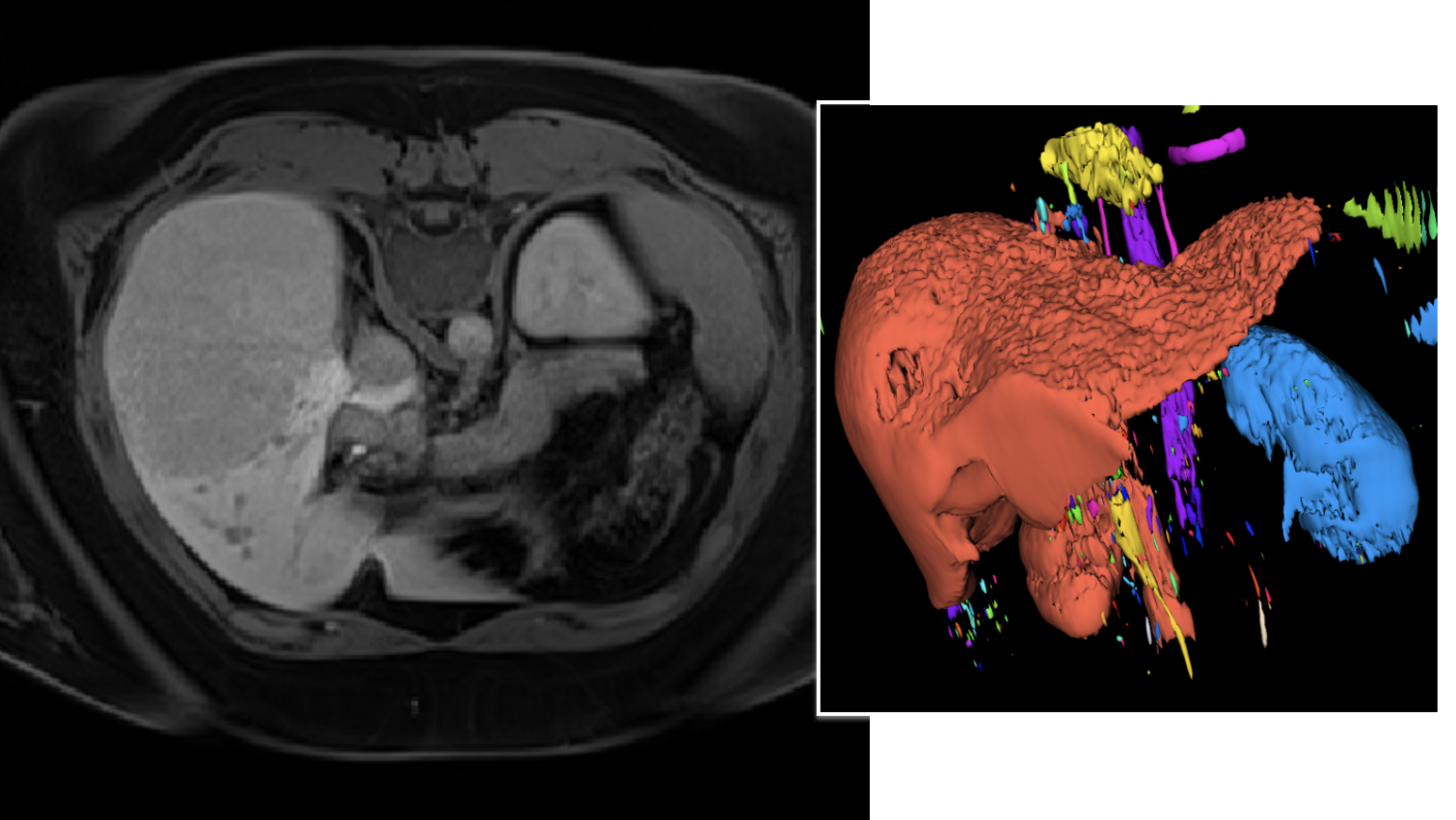
Motivation: When a patient is diagnosed with liver or kidney disease requiring an organ transplant, magnetic resonance imaging (MRI) is increasingly used to create a 3D representation of the relevant organ for 3D printing. Doctors then use this model to compare the patient’s organ with that of the donor, plan the operation, train the team, and inform the patient. These MRIs are acquired in short sessions to prevent distortion due to patient motion. However, due to scanning speed, the resolution of the resulting MRI data tends to be significantly lower in one of the axes, compromising the validity of the procedure and thus the outcome of the operation.
The project aims to reconstruct MRI scans with high resolution in every axis via deep neural networks, extract accurate 3D organ models from liver and kidney MRI data using state-of-the-art segmentation techniques, and deploy the resulting workflow into a clinically relevant environment.
Details: The student will develop the deep learning MRI super-resolution reconstruction and integrate it into a stand-alone C++ 3D CAD environment. They will learn to process and convert the project outputs into standard formats for use in downstream applications like 3D printing and finite element analysis. The project is co-supervised by Mirrakoi, a spin-off of the EPFL’s Biomedical Imaging Group (BIG) in biomedical 3D meshing and surfacing. The project is also part of an ongoing effort at BIG to develop reconstruction methods to obtain volumes with isotropic resolution from biomedical data.
The project aims to reconstruct MRI scans with high resolution in every axis via deep neural networks, extract accurate 3D organ models from liver and kidney MRI data using state-of-the-art segmentation techniques, and deploy the resulting workflow into a clinically relevant environment.
Details: The student will develop the deep learning MRI super-resolution reconstruction and integrate it into a stand-alone C++ 3D CAD environment. They will learn to process and convert the project outputs into standard formats for use in downstream applications like 3D printing and finite element analysis. The project is co-supervised by Mirrakoi, a spin-off of the EPFL’s Biomedical Imaging Group (BIG) in biomedical 3D meshing and surfacing. The project is also part of an ongoing effort at BIG to develop reconstruction methods to obtain volumes with isotropic resolution from biomedical data.
- Supervisors
- Pol del Aguila Pla, pol.delaguilapla@epfl.ch, 0767898558, BM 4.141
- Pablo Garcia-Amorena, pablo.garcia-amorena@mirrakoi.com, Mirrakoi