
Biomedical Imaging Group
Logo EPFL
    • Splines Tutorials
    • Splines Art Gallery
    • Wavelets Tutorials
    • Image denoising
    • ERC project: FUN-SP
    • Sparse Processes - Book Preview
    • ERC project: GlobalBioIm
    • The colored revolution of bioimaging
    • Deconvolution
    • SMLM
    • One-World Seminars: Representer theorems
    • A Unifying Representer Theorem
Follow us on Twitter.
Join our Github.
Masquer le formulaire de recherche
Menu
BIOMEDICAL IMAGING GROUP (BIG)
Laboratoire d'imagerie biomédicale (LIB)
  1. School of Engineering STI
  2. Institute IEM
  3.  LIB
  4.  Student Projects
  • Laboratory
    • Laboratory
    • Laboratory
    • People
    • Jobs and Trainees
    • News
    • Events
    • Seminars
    • Resources (intranet)
    • Twitter
  • Research
    • Research
    • Researchs
    • Research Topics
    • Talks, Tutorials, and Reviews
  • Publications
    • Publications
    • Publications
    • Database of Publications
    • Talks, Tutorials, and Reviews
    • EPFL Infoscience
  • Code
    • Code
    • Code
    • Demos
    • Download Algorithms
    • Github
  • Teaching
    • Teaching
    • Teaching
    • Courses
    • Student projects
  • Splines
    • Teaching
    • Teaching
    • Splines Tutorials
    • Splines Art Gallery
    • Wavelets Tutorials
    • Image denoising
  • Sparsity
    • Teaching
    • Teaching
    • ERC project: FUN-SP
    • Sparse Processes - Book Preview
  • Imaging
    • Teaching
    • Teaching
    • ERC project: GlobalBioIm
    • The colored revolution of bioimaging
    • Deconvolution
    • SMLM
  • Machine Learning
    • Teaching
    • Teaching
    • One-World Seminars: Representer theorems
    • A Unifying Representer Theorem

Students Projects

Proposals  On-Going  Completed  

Physics-based active contour energy to prevent twisting of parametric spline snakes

Spring 2015
Master Semester Project
Project: 00291
00291
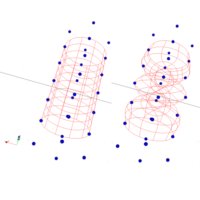
Spline snakes have been proven to be efficient segmentation models in bioimaging. They enable shape representation (curves and surfaces) in the continuous domain with only few control points using compactly supported basis functions. Advantages of these models include fast optimization schemes and intuitive user-interactivity, because moving a control point directly influences local deformation of a shape. This project aims at developing a novel energy term that prevents the snake from twisting and self-intersecting. The underlying idea is to use Coulomb’s law to place charged electrons (discretely or in the continuum) at specific locations on the contour. Internal repulsive charges will favor non-self-intersecting shapes of the snake. The project consists in A) a theoretical aspect where the student should work out the equations based on physical laws for 2D and 3D shapes and B) a practical aspect where the corresponding energy will be implemented into our existing framework. The result will be tested with artificial data and ideally be applicable to segment the aorta in 3D MRI and CT images with our existing cylindrical snake. The student should be familiar with vector analysis and objective-oriented programming such as Java or C++.
  • Supervisors
  • Daniel Schmitter, daniel.schmitter@epfl.ch, 21 693 5136, BM 4.138
  • Michael Unser, michael.unser@epfl.ch, 021 693 51 75, BM 4.136
  • Pedram Pad (pedram.pad@epfl.ch), Anaïs Badoual (anais.badoual@epfl.ch)
  • Laboratory
  • Research
  • Publications
  • Code
  • Teaching
    • Courses
    • Student projects
Logo EPFL, Ecole polytechnique fédérale de Lausanne
Emergencies: +41 21 693 3000 Services and resources Contact Map Webmaster email

Follow EPFL on social media

Follow us on Facebook. Follow us on Twitter. Follow us on Instagram. Follow us on Youtube. Follow us on LinkedIn.
Accessibility Disclaimer Privacy policy

© 2025 EPFL, all rights reserved